Calories on restaurant menus in Dubai and Abu Dhabi: what the rules say
Calorie labelling on UAE menus is often described as mandatory. The official Dubai Municipality guide is more nuanced: showing calories is voluntary for most restaurants, but once you show them, or make "healthy" claims, there are clear rules on how.
In Dubai, calorie labelling on menus is voluntary for most restaurants under the Dubai Municipality calorie guide (version of November 2020). But a restaurant that shows calories or makes healthy claims must follow it: calories next to the item name or price in a font no smaller than the name or price, plus the 2,000 calorie daily intake statement.
This guide summarises official documents checked on 26 November 2026. It is not legal advice. Rules in the UAE change, and press reports sometimes run ahead of the official text, so confirm with Dubai Municipality (or ADAFSA and DCT in Abu Dhabi) before you print.
Is calorie labelling mandatory in Dubai?
For most restaurants, not at the moment, according to the official text. Dubai Municipality's Calorie Declaration and Healthy Claims in Food Service Establishments guide (version 30, 22 November 2020) says its requirements are not mandatory unless the establishment is certified under the scheme. Its labelling section does apply, however, to outlets that already show calories or nutrients, or that make "healthy" claims on their menus.
A 2019 plan would have made calorie display compulsory, starting with chains of more than five branches. In July 2019 Gulf News reported that it had been deferred and made optional. We found no official document making it mandatory since then.
You do not have to show calories in Dubai. If you do, show them the way the guide describes.
Who the Dubai guide covers
The guide lists restaurants, cafés, bakeries, food counters in supermarkets and petrol stations, kiosks, food carts, catering, canteens and clubs. It does not treat chains differently from single outlets.
How to show calories if you choose to
- Next to the item. Show the word "Calories" or "Cal" next to the item name or the price.
- Same size or bigger. The calorie figure must be in a font no smaller than the item's name or price.
- The daily intake statement. Add: "2000 calories a day is used for general nutrition advice for youth and adults (ages 13 and older) while 1500 calories for children (ages 4 to 12), but individual needs vary."
- More information on request. Outlets making healthy, nutrition or health claims must also say "Additional nutrition information is available upon request" at the top or bottom of the first menu page.
Which menus count
| Where the menu appears | Covered by the guide? |
|---|---|
| Printed menus | Yes |
| Digital and online menus, including QR menus | Yes |
| Menu boards, in store and drive-through | Yes |
| Self-order kiosks and apps | Yes, counted as menus |
| Tags and tray mats | Yes |
| Delivery platforms and social media ads | Voluntary |
| Other marketing materials | Voluntary |
Telling guests the calories out loud does not count as declaring them. Custom orders, daily specials, market tests and temporary items are exempt.
Where to get the numbers
Calories must be accurate, so they should come from recipe analysis (nutrition software, or a food lab) using your actual recipes and portion sizes. Re-check them when a recipe or portion changes. A wrong number on a menu is worse than no number.
Abu Dhabi: healthy options in hotel restaurants
In Abu Dhabi the rule that is in force is about healthy options rather than calorie counts. Department of Culture and Tourism Circular 7 of 2026 (11 June 2026) applies to hotel restaurants and food outlets with a DCT tourism licence:
- At least one healthy option in every adult menu category.
- Healthy options for 50% of children's menu items.
- Healthy items marked with the approved SEHHI logo.
- A grace period from 1 July 2026, with full compliance and enforcement from 1 October 2026.
Khaleej Times reported in October 2026 that every menu in Abu Dhabi will carry calorie counts by the first quarter of 2027. We did not find the official regulation behind that report yet, so watch for it from ADAFSA or DCT.
Allergens are a different rule, and it is not optional
Calories are voluntary in Dubai, but allergens are not. The Dubai Food Code says allergens must be declared on the label or the menu, however small the amount, and that foods with allergens or non-halal ingredients shall be clearly identified on the menu. It lists nine: crustaceans, peanuts, soybeans, tree nuts, sesame, fish, egg, milk, and cereals containing gluten. For food served to eat straight away, the information can be shown or given to the guest on request.
Showing calories on a QR menu
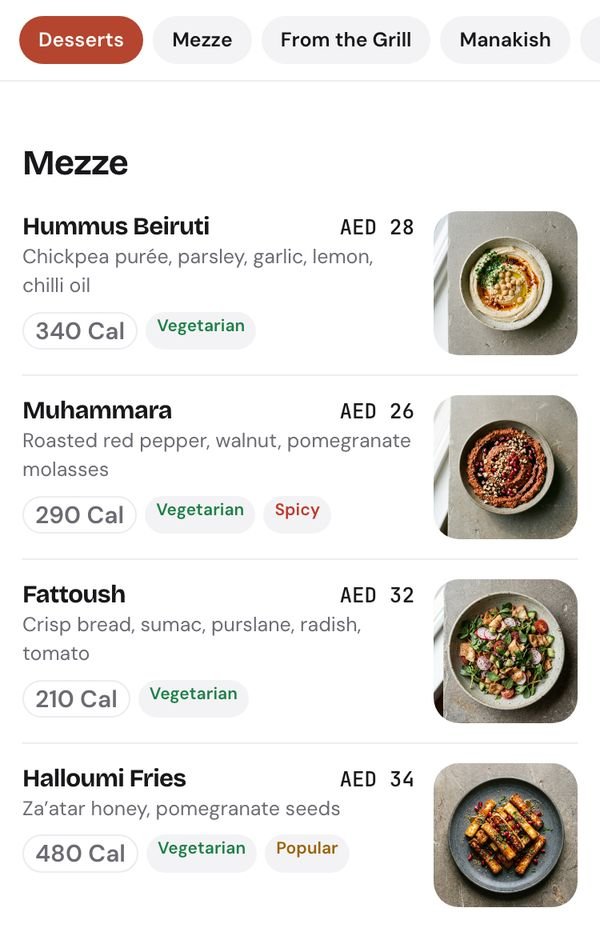
A digital menu makes calories easier to keep right, because you change a recipe's number once instead of reprinting. In WOW Table you add calories to each dish and switch "Show calories on the menu" on. The guest menu then shows the figure as "Cal" next to the dish, at least as large as the price, and adds the 2,000 calorie daily intake statement at the bottom of the menu, in English and Arabic. You stay responsible for the numbers being accurate. Try it with your menu.
Questions
Is calorie labelling mandatory in Dubai restaurants?
Not for most restaurants. Dubai Municipality's calorie guide (November 2020) says its requirements are not mandatory unless the outlet is certified under the scheme, but outlets that show calories or make healthy claims must follow its labelling rules.
What calorie statement do Dubai menus need?
If you show calories: "2000 calories a day is used for general nutrition advice for youth and adults (ages 13 and older) while 1500 calories for children (ages 4 to 12), but individual needs vary."
Does the Dubai calorie guide apply to QR and digital menus?
Yes. Printed, digital and online menus, menu boards, kiosks and apps are covered. Delivery platforms and social media ads are voluntary.
What font size must calories be on a menu in Dubai?
No smaller than the font of the item name or price, shown next to the name or price with the word "Calories" or "Cal".
What are the Abu Dhabi healthy menu rules for hotels?
DCT Circular 7 of 2026 requires hotel restaurants and DCT-licensed outlets to offer at least one healthy option per adult menu category and healthy options for 50% of children's items, marked with the SEHHI logo, enforced from 1 October 2026.
Which allergens must be on a menu in Dubai?
The Dubai Food Code lists crustaceans, peanuts, soybeans, tree nuts, sesame, fish, egg, milk and cereals containing gluten, and asks for foods with allergens to be clearly identified on the menu.
Sources
- Dubai Municipality: Calorie Declaration and Healthy Claims in Food Service Establishments, v30 (22 Nov 2020)
- Gulf News: calorie display in Dubai menus delayed for two years (21 Jul 2019)
- DCT Abu Dhabi Circular 7 of 2026: mandatory minimum healthy food options in hotel restaurant menus (11 Jun 2026)
- Khaleej Times: Abu Dhabi menus to carry calorie counts (26 Oct 2026)
- Dubai Municipality: Food Code (2013), sections 3.4.3 and 8.3
Checked 27 Nov 2026. Rules and prices change, so check the source before you rely on it.